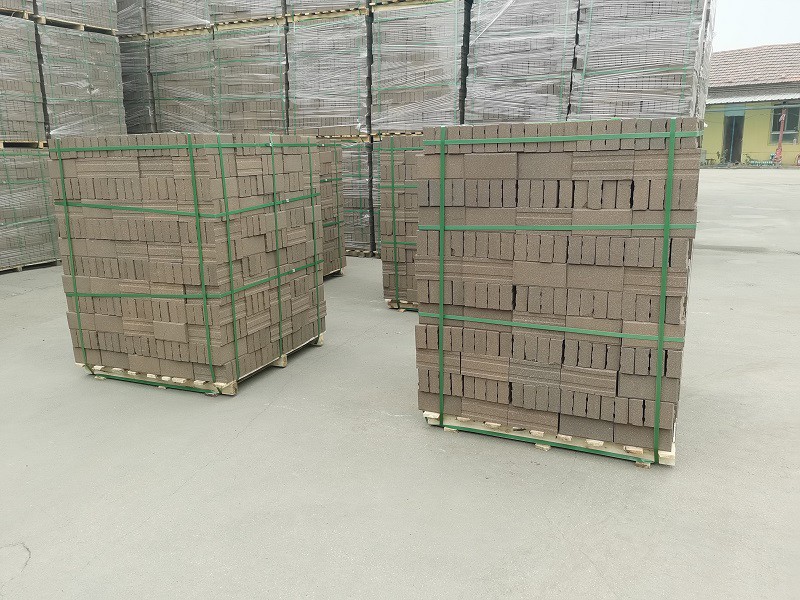
Specification for laying fired bricks
Fired bricks are the main material for paving and are also used in greening on both sides of roads. As it is exposed in public places, the aesthetic appearance of the paving is very important. As a manufacturer, our company introduces the specifications for fired brick paving to everyone.
1、 Preparation work for paving
Check the size and then proceed with the base treatment. Clean up the debris on the ground cushion layer, and if there is any hollowing, pour it again. Clean up the sludge and mortar on the cushion layer.
Try to assemble. According to the color and pattern, try to assemble and arrange non whole pieces neatly at the corners.
Pre draw the dividing line. It plays a fixed role, and records should be kept during the process to facilitate checking whether the control lines have shifted at any time (due to the large size error of this batch of bricks, the distance between the control lines should not exceed 2 meters longitudinally and 0.5 meters transversely). The surface elevation should also be determined based on the measured elevation line, and the horizontal elevation control line should be drawn.
Test arrangement. Based on the construction drawings, determine the paving style and check if the gaps between the bricks meet the requirements.
2、 Formally paved.
① Soak the bricks in water first, and when they dry in the shade and there is no water left, they can be laid. Based on the confirmed style during trial assembly and the gaps in the trial layout (generally within 3mm), a cross control line was drawn on site, with one line laid vertically and horizontally as the standard for large-scale paving.
② Trial laying, that is, lifting the bricks and aligning the vertical and horizontal control lines, laying them on the already laid dry and hard mortar leveling layer, and tapping them with a rubber hammer.
③ After compacting the mortar to the laying height, lift the fired bricks aside and check if the surface of the mortar matches the plate. If any voids are found, fill them with mortar.
④ Formally tiling, scrape a layer of cement paste (1:0.5) on the back of the brick, place it with all four corners falling down at the same time, lightly tap with a rubber hammer or wooden hammer, and level it with a ruler according to the horizontal line. After laying one piece, lay it in sequence towards both sides and backward direction.
⑤ After laying the vertical and horizontal sections, there are standards that can be divided into sections and laid in sequence.
In addition, the specifications for fired brick paving also require consideration of product width, depth, and construction environment to ensure project quality.